
Why Near Miss Reporting Matters

Near miss reporting is one of the most effective ways to prevent workplace incidents. It provides early warning of risk, highlights issues before they lead to harm, and helps organisations understand how work is actually carried out — not how it is assumed to be carried out on paper. When used properly, it allows action to be taken before something goes wrong, rather than reacting afterwards.
What Is a Near Miss?
A near miss is any unplanned event that had the potential to cause injury, ill health, damage, or loss — but did not result in harm on that occasion.
The key point is potential. The absence of injury does not mean the absence of risk.
Common examples include:
- A slip or trip where the person recovers their balance
- A falling object that narrowly misses someone
- Contact with equipment that could have caused injury
- A trailing cable spotted across a walkway before someone trips
- Vehicles or plant coming into close proximity without collision
These events often occur under normal working conditions, not unusual circumstances. This is what makes them valuable — they show how risk presents itself during everyday tasks.
Near misses are sometimes dismissed as minor or insignificant. In practice, they are often the clearest indication that something within the health and safety management system is not working as intended.
Why Near Miss Reporting Is a Good Idea?
It Identifies Risk at the Earliest Stage
Near misses provide advance warning of hazards that are already present within the workplace. They highlight situations where people have been exposed to risk, even if no harm occurred. This allows action to be taken before that exposure leads to injury. Unlike accidents, which confirm that controls have failed, near misses identify weaknesses while there is still an opportunity to intervene. This makes them one of the most useful sources of proactive safety information.
It Highlights Weaknesses in Existing Controls
Control measures may exist, but that does not mean they are effective.
Near misses often reveal that controls are:
- Missing altogether
- Inadequate for the level of risk
- Not being followed in practice
- Poorly understood or implemented
For example, a trailing cable may indicate poor housekeeping, inadequate routing of services, or a lack of supervision.
Identifying these issues early allows improvements to be made before a control failure results in injury.
It Supports Legal Duties
Near miss reporting supports compliance with key health and safety legislation, including:
- The Health and Safety at Work etc. Act 1974
- The Management of Health and Safety at Work Regulations 1999
Employers are required to identify hazards, assess risks, and implement appropriate control measures.
Near miss reporting provides evidence that:
- Hazards are being identified
- Risks are being monitored
- Action is being taken to prevent harm
While near misses are not typically reportable under RIDDOR, failing to act on known risks may have legal consequences.
The relationship between near misses and more serious incidents
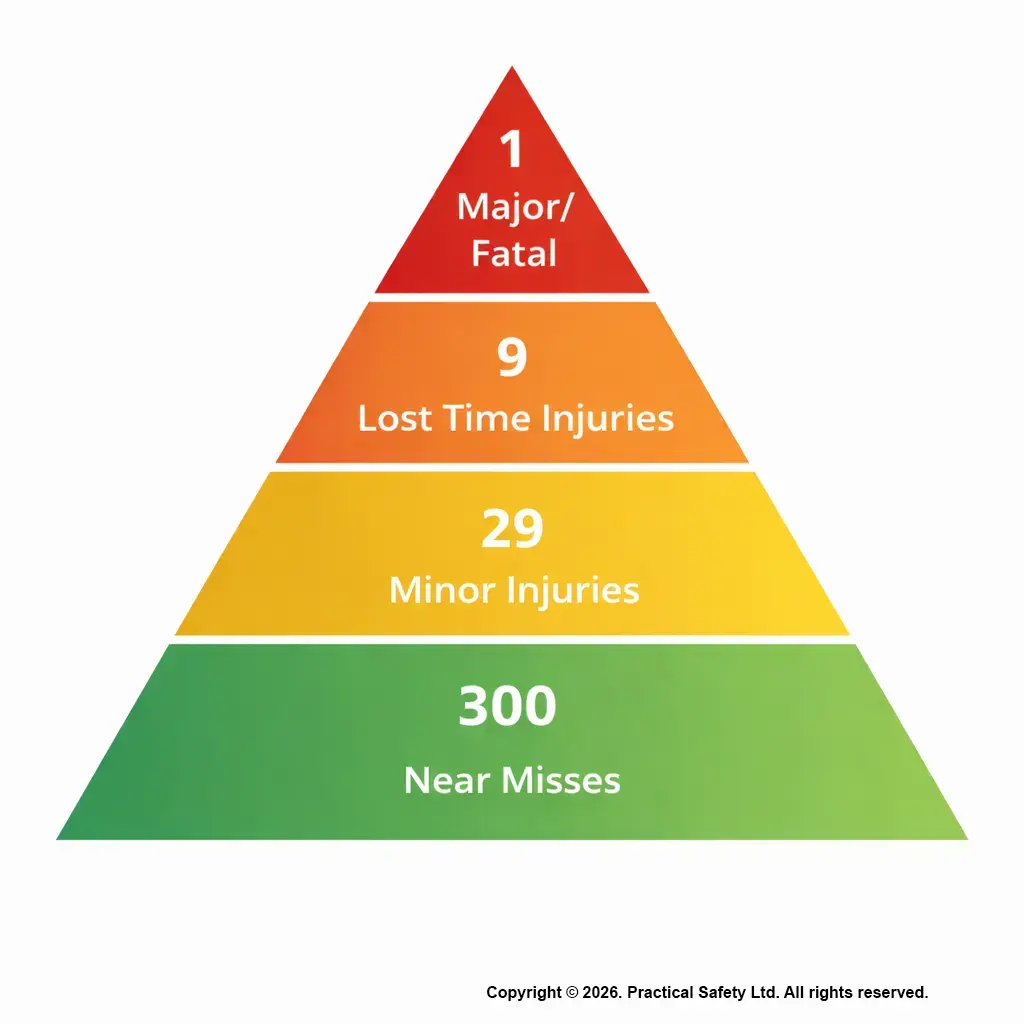
The relationship between near misses and more serious incidents is often illustrated using the accident pyramid.
This relationship is often illustrated using the accident pyramid adjacent.
This shows a typical relationship:
- 1 Major / Fatal injury
- 9 Lost Time Injuries
- 29 Minor Injuries
- 300 Near Misses
This model highlights that serious incidents are rarely isolated events.
They are typically preceded by repeated near misses and lower-level incidents, often involving the same hazards or conditions.
While the exact ratios may vary between organisations, the principle remains consistent:
Where near misses are present, there is a higher likelihood of more serious outcomes if no action is taken.
Ignoring near misses does not remove the risk — it allows it to remain and potentially escalate.
Making Near Miss Reporting Effective
To be effective, reporting systems need to be practical, proportionate, and aligned with how work is carried out.
Keep It Simple
Reporting should be quick and easy.
If the process is time-consuming or overly detailed, it will not be used consistently, particularly in busy or operational environments.
A simple description of the issue, location, and potential outcome is often sufficient.
Make It Accessible
All workers should be able to report near misses easily.
This may include:
- Paper forms in accessible locations
- Mobile or digital reporting tools
- Verbal reporting through supervisors
The method should reflect the nature of the work and the workforce.
Remove Blame
Near miss reporting should focus on identifying and managing risk, not assigning fault.
Where individuals fear blame or disciplinary action, reporting will decrease and valuable information will be lost.
A no-blame approach encourages openness and supports learning.
Act on What Is Reported
Reports must lead to review and, where necessary, action.
This may include:
- Removing hazards
- Improving controls
- Updating procedures
- Providing additional training
Failure to act undermines confidence in the system and discourages future reporting.
From Reporting to Improvement
Near miss reporting is only valuable if it leads to improvement.
This requires a structured and consistent approach:
- Reviewing individual reports
- Identifying patterns and recurring issues
- Investigating underlying causes
- Implementing practical, proportionate control measures
- Monitoring whether those measures are effective
Over time, this creates a feedback loop where information from the workplace is used to continuously improve safety performance.
How Practical Safety Ltd Can Help
At Practical Safety Ltd, we support organisations in developing practical, effective health and safety systems.
We can assist with:
- Designing and implementing near miss reporting processes
- Providing near miss reporting forms, templates, and supporting documentation
- Reviewing existing arrangements and identifying practical improvements
- Integrating findings into risk assessments and safe systems of work
- Providing training to support effective reporting and investigation
- Supporting compliance with UK legislation and recognised standards
Our approach focuses on what works in practice — ensuring systems are usable, proportionate, and effective in real working environments.
Conclusion
Near miss reporting is a practical and effective tool for managing risk.
It provides early visibility of hazards, supports informed decision-making, and allows organisations to take action before harm occurs.
When implemented properly, it leads to fewer incidents, better control of risk, and a stronger, more proactive approach to health and safety.
Contact us today to discuss your requirements.
Disclaimer: This blog post is intended to provide general information purposes only. It should not be relied upon as legal or professional advice. Employers should always consult relevant UK legislation and, where necessary, seek competent health and safety advice tailored to their specific circumstances. Practical Safety Ltd aims to avoid, but accepts no liability, in the case that any information stated is incorrect, incomplete, or out of date.


